Through a judge’s lens: 2026 World Press Photo Contest
Across screens and continents, jurors studied some of the most powerful images to decide on which ones would shape how 2025 is remembered visually.
The process was not easy – something I instinctively knew when invited to be a judge for the 2026 World Press Photo Contest.
The contest is one of the most respected awards in photojournalism and documentary photography. For 2026, there were 57,376 works by 3,747 photographers from 141 countries submitted. From this vast pool, an independent jury selected 42 winners based on visual quality, storytelling, originality and a commitment to diversity.
Founded in the Netherlands in 1955, the annual contest adopted a regional model in 2021 to better reflect the world it covers. Entries are first judged within six regions by juries with local knowledge of their political, social and cultural contexts, before progressing to the regional and global jury chairs. The aim is to widen representation and give stronger visibility to stories from every corner of the world.
From the pool of winners, the top three photos are selected.

(From left) Asia-Pacific and Oceania jury chair Yasuyoshi Chiba, North and Central America jury chair Marie Monteleone, Global jury chair Kira Pollack, South America jury chair Gael Almeida, West, Central and South Asia jury chair Gabrielle Fonseca Johnson, and Europe jury chair Silvia Omedes, at the global live judging conducted in Amsterdam in February 2026.
PHOTO: FRANK VAN BEEK
Ms Kira Pollack, the global jury chair for 2026, said: “This is a critical moment – for democracy, for truth, for the question of what we as a society are willing to see and call out and what we are willing to ignore. The photographers recognised here have done their part. They have made the record. Now it is our turn to look.”
At the event announcing the top three winners on April 23, Ms Pollack said: “Photojournalism has never been easy work. It has never been lucrative, or safe, or guaranteed an audience. And yet photographers go. To the courthouses and the conflict zones, to the quiet corners of the world where history is being made without witnesses. They go because they believe that seeing matters. That evidence matters.”
The 2026 World Press Photo of the Year winner is Ms Carol Guzy of ZUMA Press agency and iWitness for the Miami Herald. Her photograph, Separated By ICE, shows the moment an Ecuadoran family is separated when US immigration agents arrest the father following a court hearing.
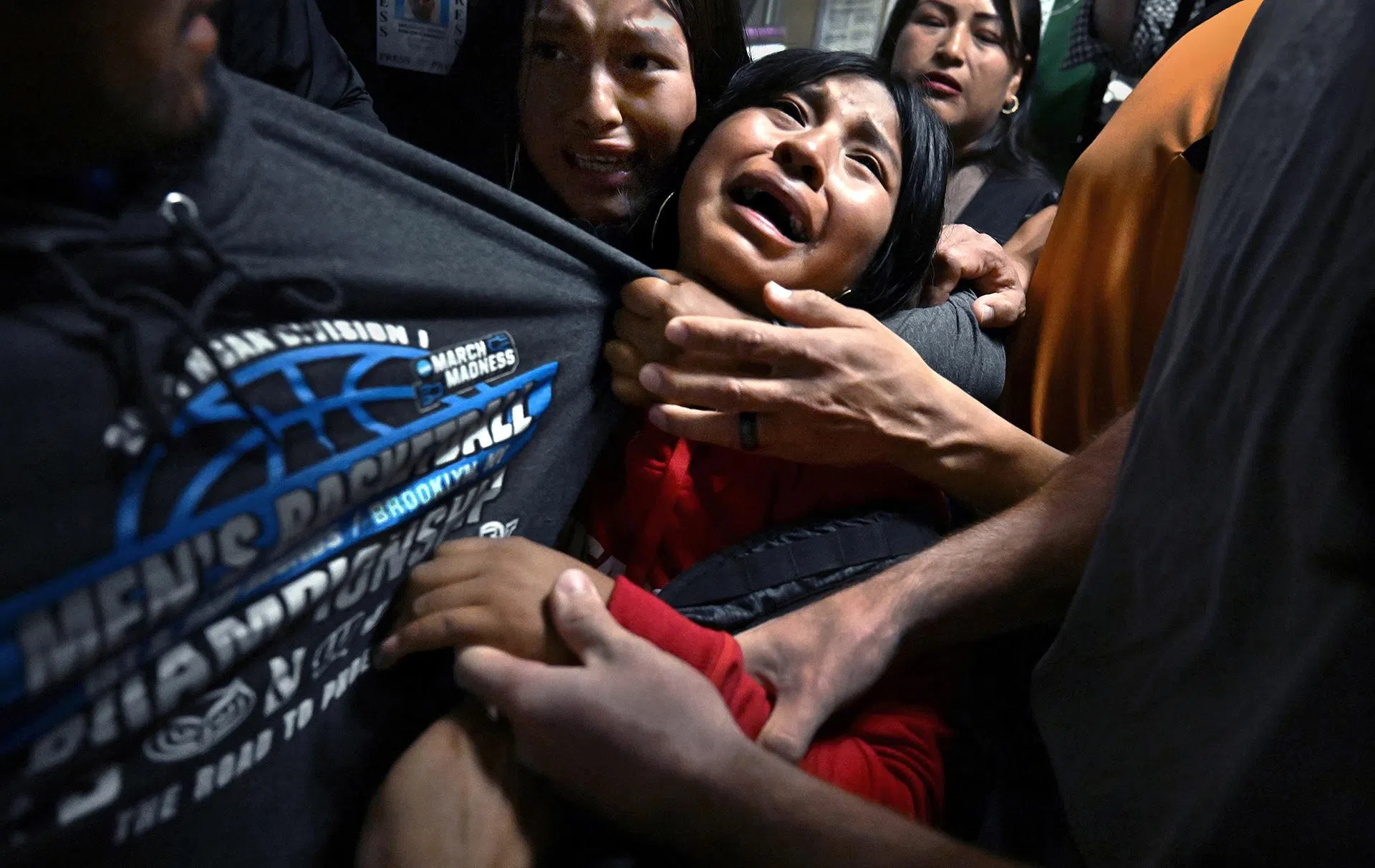
SEPARATED BY ICE: Distraught girls clinging to their father as he was detained by the US Immigration and Customs Enforcement (ICE) on Aug 25, 2025. Shifts in US immigration policy led to mass deportations of undocumented migrants. Many were detained outside courthouses immediately after hearings, resulting in traumatic family separations.
PHOTO: CAROL GUZY, ZUMA PRESS, IWITNESS, FOR MIAMI HERALD
“We bear witness to the suffering of countless families, but also to their grace and resilience that transcends adversity that has been quite humbling,” Ms Guzy said in a statement.
Mr Saber Nuraldin from EPA Images was a finalist with a shot of Palestinians swarming an aid truck in Gaza, scrambling for flour during a brief pause in Israel’s blockade.
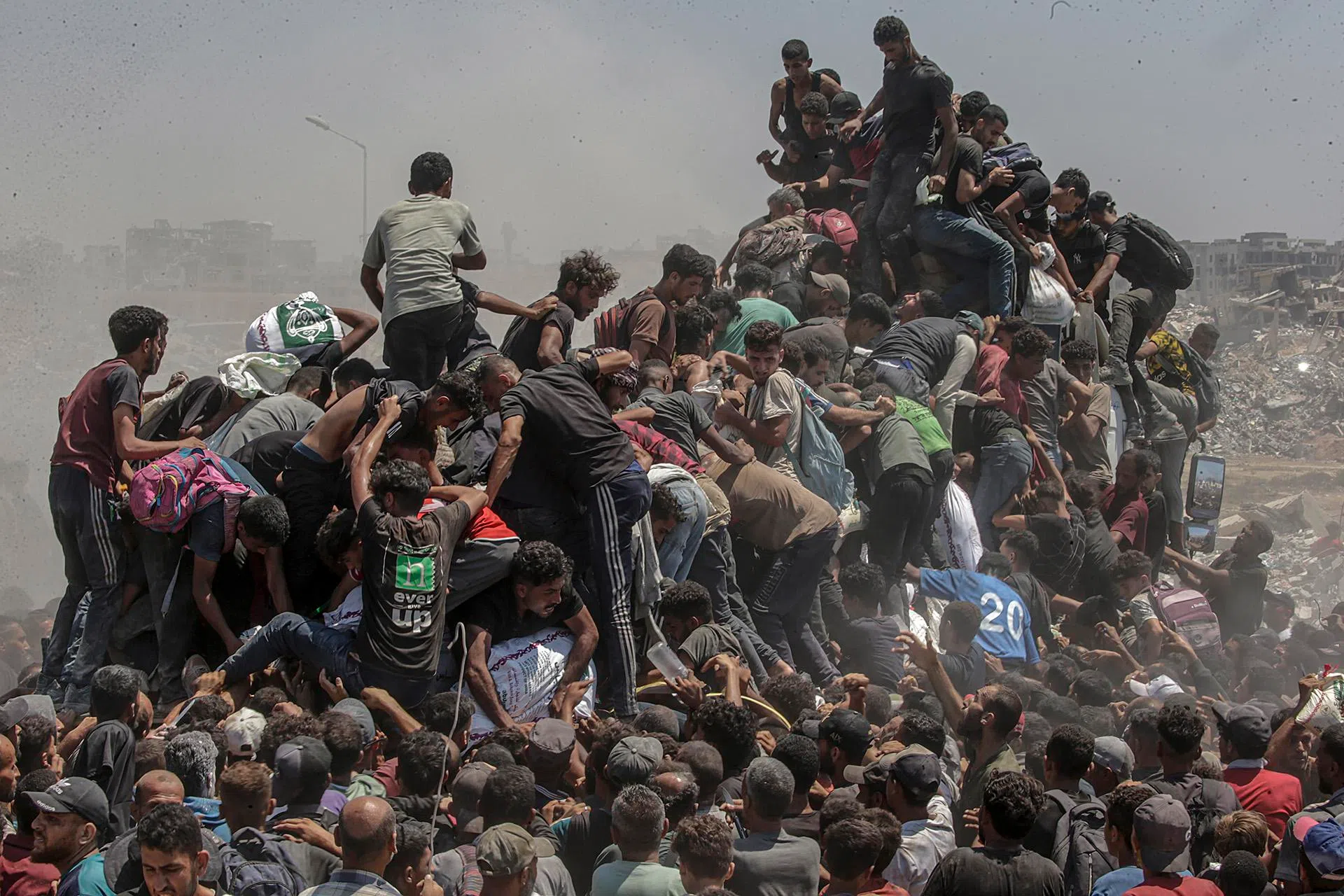
AID EMERGENCY IN GAZA: Palestinians climbing onto an aid truck on July 27, 2025, as it enters the Gaza Strip via the Zikim crossing, in an attempt to procure flour during the Israeli military’s “tactical suspension” in operations to allow humanitarian aid through.
PHOTO: SABER NURALDIN, EPA IMAGES
Mr Victor J. Blue for The New York Times Magazine was another finalist with his portrait of indigenous Achi women in Guatemala who won a legal battle against paramilitary forces who committed atrocities during the country’s civil war.

THE TRIALS OF THE ACHI WOMEN: Ms Paulina Ixpata Alvarado and other Achi women outside a Guatemala City court on May 30, 2025. That day, three former civil defence patrollers were each sentenced to 40 years’ prison for rape and crimes against humanity.
PHOTO: VICTOR J. BLUE, FOR THE NEW YORK TIMES MAGAZINE
Most people encounter the winners only after they are announced – the images that circulate globally, spark debate and come to define a year. What they do not see is the long stretch of looking, discussing, doubting and deciding that comes before any result.

WHEN GIANTS FALL: Professional hunters shooting a family of elephants identified for culling at Sango Wildlife Conservancy, Save Valley Conservancy, Zimbabwe, on Oct 23, 2025. In 2025, the Zimbabwe government authorised the culling of 50 elephants in the Save Valley Conservancy.
PHOTO: HALDEN KROG, FOR DAILY MAIL

JOBURG BALLET SCHOOL: Young dancers from the Joburg Ballet School backstage at the Soweto Theatre during their year-end performance at Soweto, South Africa, on Dec 7, 2025. The Joburg Ballet School offers subsidised training to children from historically disadvantaged backgrounds, with locations in Soweto, Alexandra, and Braamfontein.
PHOTO: IHSAAN HAFFEJEE, FOR GROUNDUP

FARISAT: GUNPOWDER’S DAUGHTERS: A troupe of “farisat (horsewomen)” galloping in unison as they fire rifles in a choreographed performance of cavalry warfare in Sidi Rahal, Morocco, on Aug 8, 2025. Tbourida is a UNESCO-recognised Moroccan equestrian tradition dating back to the 16th century, but women were historically excluded until Morocco’s 2004 family code reforms strengthened women’s legal rights.
PHOTO: CHANTAL PINZI, PANOS PICTURES

MOON DUST: Amal holds an X-ray of her lungs. She moved to Moon Valley at three years old and developed asthma within months. Alexandria, Egypt, on Jan 31, 2018. More than 30,000 residents of Wadi El-Qamar, also known as Moon Valley, in western Alexandria, Egypt, live less than 15 meters from a cement factory that fills their homes with toxic dust. Children are born with asthma. Families suffer from lung disease and irreversible respiratory damage.
PHOTO: MOHAMED MAHDY, ARAB DOCUMENTARY PHOTOGRAPHY PROGRAM
Judging the 2026 contest was an intensive, multi-stage process spread over six weeks in January and February. Before judging began, jurors were offered trauma-awareness training on handling graphic and distressing imagery – an important step, given that many photographs came from scenes of war, disaster, violence and loss.

NEPAL’S GEN Z UPRISING: Fire and smoke engulf Singha Durbar after protesters stormed and set the government complex alight during violent demonstrations in Kathmandu, Nepal, on Sept 9, 2025. A government ban of 26 social media platforms on Sept 4 was the breaking point for Nepal’s youth. On Sept 8, thousands took to the streets, part of a generation of young people around the world refusing to accept systems that perpetuate corruption, unemployment, and economic hardship.
PHOTO: NARENDRA SHRESTHA, EPA IMAGES

“I’M AFRAID”: Atifa assisting in what she says will be her last delivery, having run out of medication and the means to continue, at the Malmastok Family Health House in Shahristan district, Daikundi province, Afghanistan, on July 22, 2025. In Afghanistan’s remote Daikundi province, US aid cuts have left pregnant women without access to care, forcing many to give birth at home in a country with one of the world’s highest maternal mortality rates.
PHOTO: ELISE BLANCHARD, FOR TIME

WITNESSING GAZA: The Mushtaha Tower collapsing in a military strike, amid hundreds of makeshift tents sheltering displaced Palestinians, as Israel’s offensive on Gaza City intensified, in the Gaza Strip, on Sept 5, 2025. In 2025, civilians in Gaza endured starvation, famine, and relentless bombardment as the death toll surpassed 75,000 and the Israeli authorities severely restricted the flow of humanitarian aid.
PHOTO: SAHER ALGHORRA, FOR THE NEW YORK TIMES

WITNESSING GAZA: Resident Tamer Hassan al-Shafei and his family breaking their Ramadan fast in the remains of their home in Beit Lahia, Gaza Strip, on March 4, 2025. Food shortages meant only basics were served instead of the usual spread. The photographer worked under immense danger, driven by a refusal to let the world turn away. “Even when everything around me told me to stop, I couldn’t – silence would mean surrender.”
PHOTO: SAHER ALGHORRA, FOR THE NEW YORK TIMES

HIJACKED EDUCATION: A Ukrainian soldier from the Ares battalion, 129th Territorial Defense Brigade, gazing out of a kindergarten window at the southern front in the Donetsk region, Ukraine, on Aug 2, 2023. Across the world, war, extremism, and displacement deny children the right to education. Schools are destroyed, teachers killed or forced to relocate, textbooks burned, and classrooms turned into barracks. The UN estimates that 85 million of the 234 million school-age children affected by conflict worldwide have no access to education at all. Since 2011, the photographer has documented this crisis across nine countries.
PHOTO: DIEGO IBARRA SÁNCHEZ
My role was on the Asia-Pacific and Oceania regional jury with four others. Together, we reviewed entries in Singles, Stories and Long-Term Projects over 10 days. It meant 10 days of studying photographs on a secure platform, including four days of Zoom sessions where we voted, compared scores, justified our choices and tried to narrow thousands of entries down to a shortlist.

A screenshot of the final session for the Asia-Pacific and Oceania judging on Jan 31, 2026. (Top row, from left) Asia-Pacific and Oceania jury chair Yasuyoshi Chiba (Japan, AFP’s chief photojournalist for Indonesia and East Timor), Naomi Purswani (World Press Photo, programmes project manager), juror Vivek Prakash (Australia, managing editor, APAC); (middle row, from left) juror Kim Kyung-hoon (South Korea, senior photographer, Reuters), Saba Askary (World Press Photo, programmes manager), Csenge Nagy-Gyorgy (World Press Photo, programmes intern); (bottom row, from left) juror Wang Hui Fen (Singapore, picture editor, The Straits Times), juror Nicky Catley (Australia, photo editor, The Sydney Morning Herald), and Noor Chehabeddine (World Press Photo, programmes coordinator).
After each four-hour Zoom session, I realised I had stopped blinking. That may sound dramatic, but the fatigue was real. Looking carefully at image after image took a kind of concentration I had underestimated. Every frame deserved attention. Every decision would affect someone’s work.
Jurors looked for work that was visually powerful, truthful and meaningful, while also weighing ethics, stereotypes and the protection of vulnerable people. By the time winners were announced, each image had been tested not only for quality, but for the responsibility of showing it to the world.

MILEI’S ARGENTINA: The police detaining Father Jorge “Chueco” Romero during a pensioners’ protest in Buenos Aires, Argentina, on May 14, 2025. Aggressive austerity measures had plunged the nation’s older people into a desperate struggle for survival.
PHOTO: TADEO BOURBON, FOR REVISTA MU

NAME THE ABSENCE: Valeria, 5, playing behind a curtain at her aunt’s house on Sept 10, 2025, in Los Patios, Norte de Santander, Colombia. She is raised solely by her mother. In her region, 30 per cent of households are headed exclusively by women. Colombia has the world’s highest rate of single mothers.
PHOTO: FERLEY A. OSPINA

THE HUMAN COST OF AGROTOXINS: Former land applicator Alfredo Ceran showing his burnt fingernails in Cordoba, Argentina, on Sept 23, 2015. After years of mixing chemical products without adequate protection, he developed non-alcoholic cirrhosis and underwent a liver transplant. In 1996, Argentina approved genetically modified, herbicide-resistant soybeans paired with glyphosate-based herbicides, a policy adopted without independent research.
PHOTO: PABLO E. PIOVANO, MANUEL RIVERA-ORTIZ FOUNDATION, PHILIP JONES GRIFFITHS FOUNDATION, LAWEN.DOC
The process was rigorous. In the early rounds, the photographers’ identities were withheld so each work could stand on its own merit. Later came captions, context, forensic checks and fact-checking. Many images did not survive that scrutiny.
The rules were strict. There were points and sub-points covering aspects from technical requirements, ethics to specific rules on the use of artificial intelligence tools. No synthetic or artificially generated images were allowed, and any use of generative fill – a generative AI tool for editing images using text prompts – meant automatic disqualification. Even smartphone entries had to be made in standard shooting mode; HDR, portrait mode and other effects were not accepted.

SCAM HUB UNDER SIEGE: Offices left in disarray in Shunda Park, a massive cyber-scam compound in Myanmar’s Karen State, seen in this Dec 5, 2025, photo, after clashes between the military and the opposition militia. When rebel forces ousted the junta-allied militia guarding the park, thousands of workers – many believed to be victims of human trafficking from around 30 nations – were stranded in Myanmar.
PHOTO: JES AZNAR, FOR THE NEW YORK TIMES

Photographs and props used to fake online personas and build relationships with victims. Min Let Pan, Myanmar, on Dec 5, 2025.
PHOTO: JES AZNAR, FOR THE NEW YORK TIMES

Stranded workers at a makeshift shelter near the Moei River in Min Let Pan, Myanmar, on Dec 5, 2025. Many workers had their documents and passports seized by the scam centre bosses and could not cross the border into Thailand.
PHOTO: JES AZNAR, FOR THE NEW YORK TIMES
What I valued most was hearing other jurors think out loud. While we were from news organisations or wire agencies, we came from different backgrounds, with different editorial instincts and lived experiences. Sometimes an image I thought I understood became clearer after someone explained the local politics, culture or history around it. More than once, I changed my mind.
For instance, we thought one shot was just another photo of a giant panda roaming its habitat in the Wanglang National Nature Reserve, in Sichuan, China.
But my jury team chair Yasuyoshi Chiba reminded us that while captive pandas are world-famous, witnessing one in the wild remains a rarity. Although China’s “panda diplomacy” has made the species a global icon, fewer than 2,000 remain in their natural habitats, with only a few dozen residing in the Wanglang reserve.

MOUNTAIN RESIDENT OF WANGLANG: A wild giant panda captured by a camera trap in the Wanglang National Nature Reserve in Sichuan, China, on Nov 11, 2025.
PHOTO: ROB G. GREEN, NATIONAL GEOGRAPHIC SOCIETY, HENRY LUCE FOUNDATION
To capture a glimpse of these elusive residents, researchers rely on strategically placed, weather-sealed camera traps that are triggered by motion. The resulting imagery offers a rare, low-angle gaze at a reclusive animal that serves as a vital symbol of the health and resilience of the high-mountain forests.
Some photographs divided opinion; one person saw originality, another saw cliche. One juror valued rare access, while another valued emotional clarity. We discussed, listened and reconsidered. No one got everything they wanted. Whenever we were stuck, we took a vote and moved on. The moderators from World Press Photo sat in on all the calls. They are seasoned in handling very “passionate” jurors.
Mr Chiba said: “We were looking for images that showed what happened in 2025, but we were also looking for something extraordinary or unexpected.”

BONDI BEACH TERROR ATTACK: An overwhelmed police officer near the bodies of victims Boris and Sofia Gurman, the first ones in a shooting attack on Dec 14, 2025, in Sydney, Australia. The two attackers had targeted a Jewish Hanukkah celebration on the beach.
PHOTO: EDWINA PICKLES, THE SYDNEY MORNING HERALD

THE LAST DOLPHIN HUNTERS: Crowds in Fouele village discussing seaweed farming with MP Rick Houenipwela on Feb 12, 2025. This new source of income offers an alternative to the traditional but controversial dolphin hunt, which has provided food and income to families in the coastal community on Maramasike Island, a low-lying island in the Solomon Islands.
PHOTO: MATTHEW ABBOTT, OCULI, FOR THE NEW YORK TIMES
Some works stayed with me more than others.
Independent Chinese photographer Wu Fang’s long-term project Motherhood At 60, about Dr Sheng Hailin, who gave birth to twin daughters at 60 after losing her only child, was a unanimous choice for our region’s Long-Term Projects nomination.

MOTHERHOOD AT 60: Dr Sheng Hailin preparing for delivery at a hospital in Hefei, Anhui Province, China, on May 25, 2010. At 60 years old and more than seven months pregnant, she faced pain, haemorrhaging, and other physical hardships to bring her twin daughters into the world. This story follows the family over 15 years.
PHOTO: WU FANG
Built over 15 years, the series of 30 black-and-white photographs followed Dr Sheng’s journey from pregnancy until the girls turned 15. It felt less like a project and more like a life witnessed with patience and trust.

Returning from a work trip, Dr Sheng Hailin is greeted by her daughter, Huihui, in Hefei, Anhui Province, China, on March 5, 2012. To support her young family, the retired doctor went back to work, travelling across China giving lectures on health.
PHOTO: WU FANG

Zhizhi with her father Wu Jingzhou at kindergarten in Hefei, Anhui Province, China, on Sept 7, 2013. A couple’s decision to have children in their 60s sparked debates online over the ethics and responsibilities of elderly parenthood.
PHOTO: WU FANG

Dr Sheng Hailin combing her daughters’ hair before school in Hefei, Anhui Province, China, on May 21, 2018. As the girls grew, Dr Sheng faced the increasing challenge of managing their daily needs while navigating her own diminishing physical capabilities.
PHOTO: WU FANG

Zhizhi and Huihui attending dance training in Hefei, Anhui Province, China, on May 23, 2021. The cost of the girls’ education and extracurricular activities placed a significant financial burden on the aging family.
PHOTO: WU FANG

Zhizhi and Huihui at their father Wu Jingzhou’s funeral procession in Hefei, Anhui Province, China, on Dec 8, 2022. He died in late 2022, leaving the 72-year-old Sheng Hailin to raise their teenage daughters alone.
PHOTO: WU FANG

Zhizhi and Huihui celebrating their 15th birthday in Hefei, Anhui Province, China, on June 12, 2025.
PHOTO: WU FANG

Dr Sheng Hailin presenting her daughters with flowers after they complete their high school entrance exams in Hefei, Anhui Province, China, on June 16, 2025. At 75, she continues to document her life online to support her family’s future.
PHOTO: WU FANG
Mr Tyrone Siu, a Hong Kong-based staff photojournalist for Reuters, captured an absolutely heart-wrenching image titled A Desperate Plea, which won an award in the Singles category in the Asia-Pacific and Oceania region. It shows a man crying out as he watches his home burn in the Tai Po housing complex in Hong Kong. Moments earlier, he had spoken on the phone with his wife, who was among the 168 victims trapped inside during the November 2025 blaze. There was nothing theatrical about it – just raw human helplessness.

A DESPERATE PLEA: Mr Wong crying out in anguish as fire engulfs the apartment complex he calls home. The blaze at Wang Fuk Court in Tai Po, Hong Kong, on Nov 26, 2025, claimed 168 lives.
PHOTO: TYRONE SIU, REUTERS
We have all seen photographs of floods, but Filipino photojournalist Aaron Favila’s Wedding In The Flood felt different. A bride enters a partially submerged church to carry on with her wedding. It held sorrow and hope in the same frame – a picture about climate reality and also about human resilience.

WEDDING IN THE FLOOD: Ms Jamaica Aguilar preparing to enter the flooded Barasoain Church in Bulacan province for her wedding on July 22, 2025, after Typhoon Wipha hit the Philippines. Located on a delta, Bulacan province is vulnerable to frequent flooding.
PHOTO: AARON FAVILA, ASSOCIATED PRESS

Inside the flooded Barasoain Church, young guests look on attentively in Malolos, Bulacan province, the Philippines, on July 22, 2025. The intensity of tropical cyclones and associated rainfall that has hit the Philippines has significantly increased since 2012.
PHOTO: AARON FAVILA, ASSOCIATED PRESS

Newlyweds sharing a kiss as guests cheer in a flooded church in Malolos, Bulacan province, the Philippines, on July 22, 2025. They have been together for 10 years.
PHOTO: AARON FAVILA, ASSOCIATED PRESS
Taken together, the winning images reflected a fractured world, but not a hopeless one. They showed abuse of power, climate pressure and personal loss, but also courage, tenderness and endurance.
(The following photo contains graphic content. Viewer discretion is advised.)

RUSSIAN ATTACK ON KYIV: Resident Valeria Syniuk, 65, sitting near her badly damaged home. She was asleep when a Russian missile destroyed the building opposite hers in Kyiv, Ukraine, on April 24, 2025. Russia had launched one of the deadliest attacks on Kyiv since the start of its full-scale invasion of Ukraine in 2022. Hours after international peace negotiations stalled again, missiles and drones struck at least five residential neighborhoods, killing 13 people and wounding 90.
PHOTO: EVGENIY MALOLETKA, ASSOCIATED PRESS

EMMA THE SOCIAL ROBOT: A resident talking to Emma, a social robot that recognises faces and remembers past conversations, in Albershausen, Germany, on July 3, 2025. Though sceptical at first, she says she felt connected to Emma over time. Germany’s care homes are facing two crises: staff shortages and loneliness. A 2023 study found that one in five residents aged 80 and older describe themselves as “severely lonely”. This reality has prompted trials of social robots like Emma, developed by a Munich-based start-up.
PHOTO: PAULA HORNICKEL

BURNED LAND: A man fighting a wildfire with a branch in Cualedro in Ourense, Galicia, Spain, on Aug 15, 2025. When resources are stretched, residents use whatever is available to extinguish flames, including branches, farming tools, and water hoses. The year 2025 was a record one for wildfires in Europe. More than 200,000ha burned across Galicia during Spain’s worst fire season in about three decades.
PHOTO: BRAIS LORENZO, EFE, REVISTA 5W, EL PAÍS

DRONE WARS: Resident Yulia Vasiakina embracing Kamelia, her 20-year-old horse, killed when Russian long-range drones struck their neighbourhood and destroyed most of the surrounding city block in Odesa, Ukraine, on July 11, 2025. Ukraine’s battle against the Russian invasion is reshaping modern combat. Hobby drones are being repurposed into remote-controlled weapons, and mass-produced first-person-view drones are piloted from kilometres away with deadly precision. These developments have triggered an unrelenting drone arms race and turned vast areas of Ukraine into “kill zones”.
PHOTO: DAVID GUTTENFELDER, THE NEW YORK TIMES

ENGLA LOUISE: Former dancer Engla Louise gathering lilacs from the Linkoping Garden Society park beside her home in Linkoping, Sweden, on May 14, 2025.. Being surrounded by beauty is important to her. She has lived with severe anorexia nervosa since she was 10 years old. At 46, she weighs less than 25kg and has been tube-fed since 2019.
PHOTO: SANNA SJÖSWÄRD, FOR CORREN

EXTRAMUROS: Mehdi, of Algerian origin and originally from the Bosquets housing project in Montfermeil, competing in a street fight organised by CanalPourss, a local initiative that uses boxing to reduce violence, in Marseille, France, on July 27, 2024. In the peripheral neighborhoods of France’s banlieues, migrant families navigate postcolonial legacies, higher rates of unemployment, and structural inequality. France’s integration system requires migrants to culturally assimilate while prejudice persists, leaving communities caught between exclusion and belonging.
PHOTO: WILLIAM KEO, LA BIBLIOTHÈQUE NATIONALE DE FRANCE, DIE ZEIT
When the final session ended, I closed my laptop and sat for a while, processing everything I had seen and deliberated on.

PORTLAND PROTESTS: Officers from the US Department of Homeland Security and other federal agencies clashing with demonstrators outside an ICE processing centre in Portland, Oregon, the US, on June 24, 2025. The intense summer protests centred on opposing the administration’s escalating mass-deportation agenda.
PHOTO: JAN SONNENMAIR

MEXICO, A CHANGING CLIMATE: A tourist boat sitting grounded after the La Boca dam dropped to 8.5 per cent capacity during the 2022 drought in Santiago, Nuevo Leon, Mexico, on June 20, 2022. Monterrey remains caught between extreme water scarcity and catastrophic, climate-driven flooding. Mexico is especially vulnerable to climate extremes, with 52 per cent of its territory situated in arid or semi-arid zones. Over the last two decades, environmental disasters have internally displaced approximately 2.7 million people, a figure projected to reach up to eight million by 2050.
PHOTO: CÉSAR RODRÍGUEZ, NORWEGIAN RED CROSS, SNCA, THE NEW YORK TIMES
What stayed with me were not just the photographs, but the people in them – their grief, their dignity, their determination. Some images win awards. The strongest ones stay with you.
Produced by: Claudette Peralta, Denise Chong, Grace Tay, Neo Xiaobin and Wang Hui Fen