When heart meets action: Shining a light on social work excellence in Singapore
The Singapore Association of Social Workers (SASW) has refreshed its long-established Outstanding Social Worker Award as the Outstanding Social Work Awards (OSWA) to focus on exemplary social work practice and research.
Introduced in 1998, the original award has recognised more than 70 social workers across its 25 editions.
With more than 2,900 accredited social workers in Singapore, the updated awards introduce two categories, OSWA (Practice) and OSWA (Practice Research), to raise public awareness, broaden understanding of the diverse fields of social work, and highlight the profession’s role in driving innovation.
“By focusing on both social work practice and practice research, the revamped awards will continue to spotlight the profession’s impact while deepening the public’s understanding of how social work addresses social issues and fosters innovation,” said Mr Chan Whee Peng, president of SASW.
The association has kept the OSWA acronym to preserve the award’s legacy while reflecting the profession’s ongoing growth.
The five award recipients for 2026 are recognised for their impactful work in youth services, person-centred care for seniors with dementia, and supporting women affected by domestic violence.

Fei Yue Community Services’ senior assistant director and lead social worker Benjamin Yeo (right) with Mr Muhammad Dzulkarnaen Abdul Wahid, who was referred to Fei Yue by his school in 2020 after he had stopped attending classes.
OSWA (Practice) recognises three outstanding social worker-led initiatives or projects that exemplify the purpose, values and impact of the profession in Singapore: Fei Yue Community Services, SHINE Children and Youth Services, and Ren Ci Hospital.
OSWA (Practice Research) honours two outstanding research projects – by Care Corner Singapore, and by Care Corner Singapore in collaboration with the Singapore Institute of Technology – that have led to improvement of social work practice.
The awards will be presented at SASW’s Social Work Day event on March 27 at Gardens by the Bay, in conjunction with World Social Work Day. Each winner will receive a certificate, an OSWA plaque and a $5,000 cash grant.
Bringing ‘hidden youth’ back into the light
In a fast-paced, competitive society where youth are increasingly withdrawing from the world around them, Fei Yue Community Services (FYCS) has taken steps to address the growing issue of socially isolated young people.
Recognising the signs, a team at FYCS pioneered Singapore’s first dedicated outreach service for “hidden youth” – a term it uses to describe people aged 12 to 25 who have withdrawn from social interactions for six months or more, not due to mental illness but in response to deeper emotional struggles.
Youngsters drift into isolation for various reasons. Technology has reduced opportunities to connect face to face, for instance. Or bullying and other negative encounters make it difficult to trust people.
In 2020, FYCS launched the Hidden Youth Outreach Service, setting out to reach these young individuals where they were – at home – and helping them to begin the long, often challenging journey of reintegration.

Mr Dzulkarnaen enjoyed playing games on his mobile phone when he was in social isolation, and one activity that Mr Yeo used to bond with the youth was playing Mobile Legends.
The team currently works directly with 100 hidden young people in Singapore. Youth are engaged through programmes such as baking, animal care, art, fishing and digital media to build trust with them and draw them out. The aim is to also build up their confidence and communication skills, and improve their social health, which is their ability to interact and form meaningful relationships with others.
To help youth before they retreat further into isolation, the team also launched ReConnect, an anonymous online counselling service. It is now supporting 40 young people who are not yet comfortable with face-to-face help.
To help hidden youth, social workers first work with parents to understand the youth and devise outreach strategies, said senior assistant director and lead social worker Benjamin Yeo, 39. He leads the team together with deputy head of department and senior social worker Zoe Tee, and assistant senior social workers Gayle Gan, 33, and Rauf Malachi Redza Fauzi, 35.
Success is measured across four milestones. The first is getting the youth to agree to meet. As trust and relationships build, the youth begins stepping out of the house. Over time, the youth develops a more positive sense of self and goals.
The final milestone is hit when the youth eventually returns to school or full-time work for more than three months.
This journey may take three years or more, Mr Yeo said.
One approach that has proven especially effective is FYCS’ animal care programme, which creates safe spaces for connection and healing. Animals like guinea pigs, hamsters, cats and even horses at care organisations help youth engage with both the animals and one another.

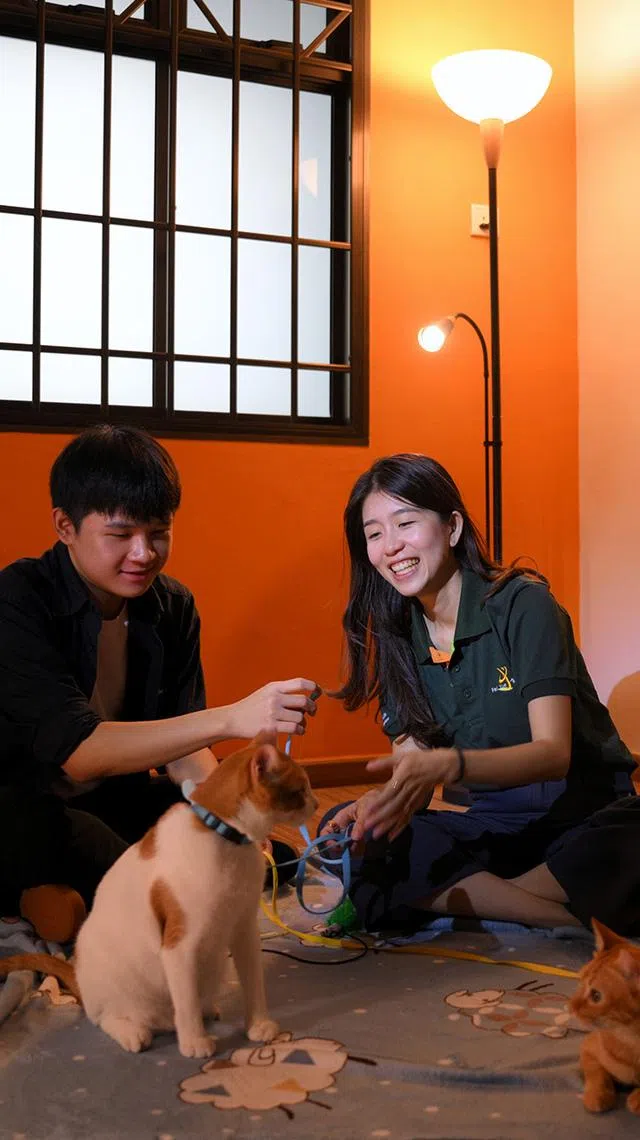
FYCS senior social worker Zoe Tee (right) and Ms Adeline Wong, founder and director of Human-Animal Bond in Ministry, during an animal-assisted intervention session with 16-year-old Goay Zhen Yi on March 7.
One participant, Goay Zhen Yi, 16, credits this programme with helping him come out of his shell. Being bullied and his difficulty in expressing himself, along with tensions at home, had led him to start isolating himself in his room at the age of nine. By Secondary 1, he had stopped going to school.
“It was like a little zoo trip every time,” said the animal lover, who was referred to FYCS in 2024. “I learnt about animals’ behaviours and personalities, and it gave me the chance to talk to others and gain confidence in myself.”

Ms Tee (right) and Zhen Yi making a toy for cats during FYCS’ animal care programme on March 7, 2026.
One of the first success stories of the programme is Mr Muhammad Dzulkarnaen Abdul Wahid, 22, who was referred to FYCS by his school in 2020 after he had stopped attending classes.
He said he had always felt out of place in school, and a few incidents made him feel betrayed by the friends he trusted. That, coupled with the fact that he did not have confidence in himself, made him start skipping school and withdrawing from the outside world in 2017 when he was 13.
A milestone in Mr Dzulkarnaen’s journey came when Ms Tee introduced him to what she calls “shopping therapy”. “He only had two sets of clothing, in black,” she recalled. “We went shopping for new clothes, and I encouraged him to try colours and styles outside of his comfort zone. That was when I saw him light up for the first time, accepting a compliment about how he looked.”
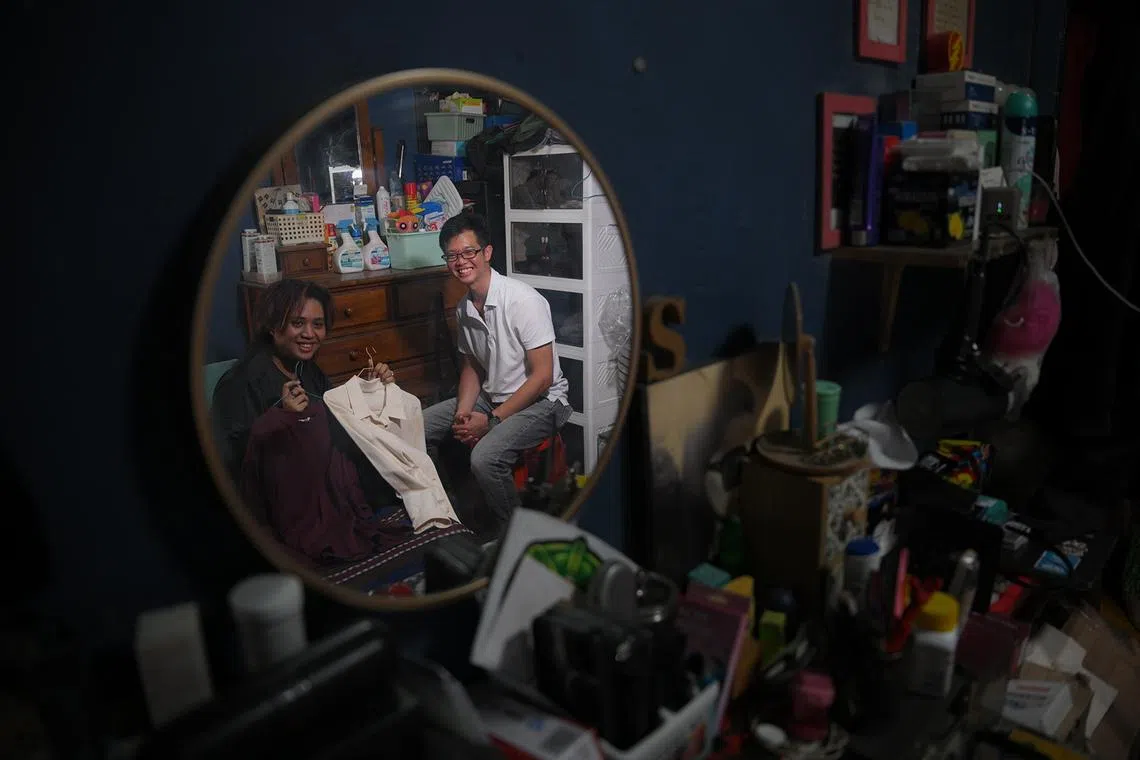
Mr Dzulkarnaen, with Mr Yeo, holding up a cream-coloured jacket and maroon T-shirt – clothing with “colours and styles outside of his comfort zone” – that he bought from Uniqlo during a “retail therapy” session with FYCS.
Said Mr Dzulkarnaen: “Social isolation felt like a prison of comfort for me. Looking back, putting on the non-black clothing felt like I was slowly learning to see myself a little differently. Breaking out of social isolation isn’t something that happens overnight; it takes time and everyone heals at their own pace.”
He returned to school in 2023 and graduated from ITE College East in February at the top of his cohort, with a perfect grade point average in mechanical engineering. He is planning to go to Singapore Polytechnic to further his studies.

“There is no one-size-fits-all solution,” said Ms Tee. “But with persistence, patience and the right support, we’re seeing transformations in these youth. The journey isn’t easy, but it’s worth it.”
Empowering youth against crime
They may not have Spider-Man’s superhuman reflexes and web-slinging abilities, but students Muhammad Albaqir, 14, and Reina Cheong, 15, are friendly neighbourhood crime fighters in their own way.
Three to five times a year, they don navy T-shirts emblazoned with a “Youth COP” crest after school and join officers from Clementi Neighbourhood Police Centre (NPC) on community patrols in the neighbourhood, where they talk to people about crimes like online scams, money laundering and shoplifting.
They are part of SHINE Children and Youth Services’ Youth COP, a longstanding crime prevention and leadership development initiative that also aims to reduce youth delinquency across Singapore.

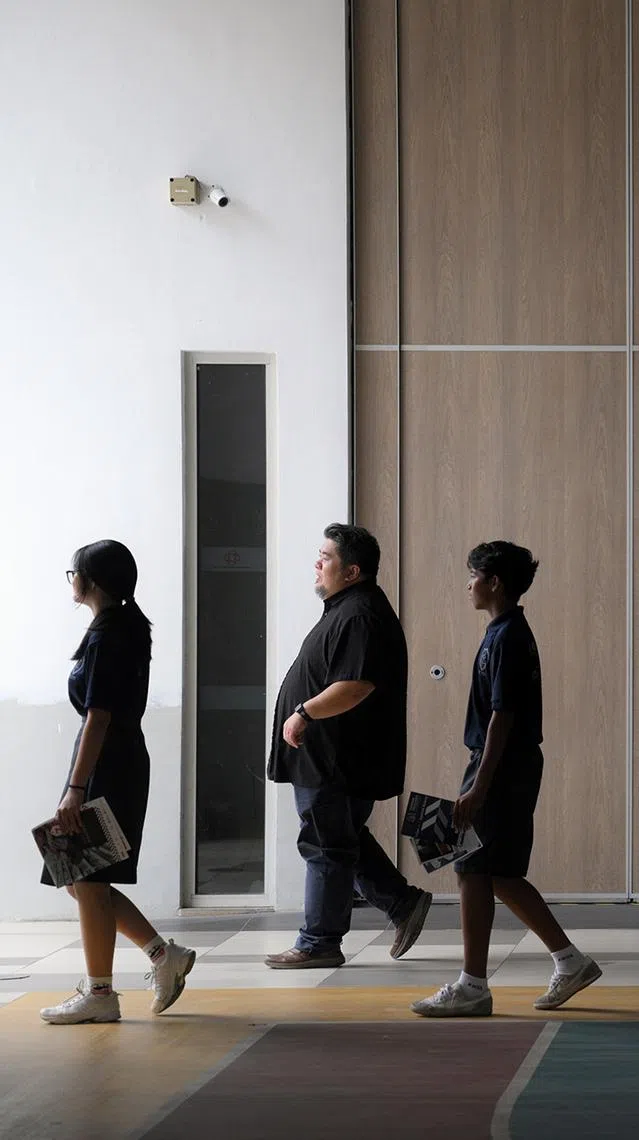
Head of Youth COP Jason Tan (centre) with Youth COP members Reina Cheong and Muhammad Albaqir at West Coast Community Centre on March 13, 2026.
Led by head of Youth COP Jason Tan, 41, and senior social worker Tan Yee Ying, 34, the programme started in 2007 as a ground-up collaboration between a secondary school, an NPC and SHINE.
Since then, more than 1,600 young people have joined as crime prevention ambassadors.
Youth COP leaders are trained in Singapore’s laws and the consequences of crimes, as well as life skills and character development, to prepare them to be crime prevention leaders.
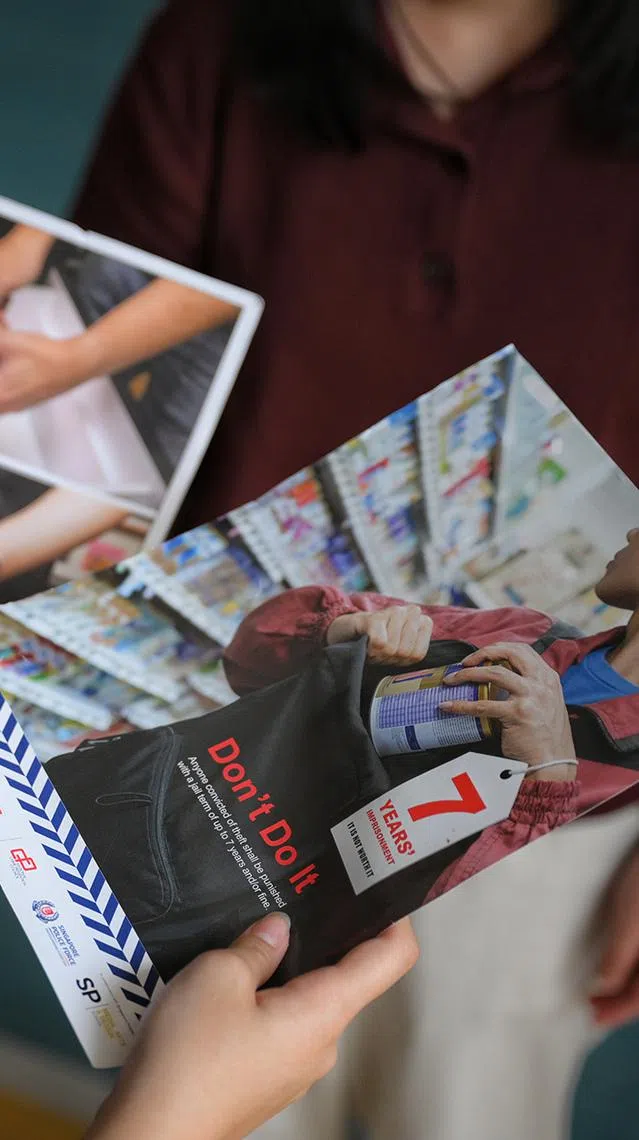
While some youth may have previously encountered challenging life circumstances, many of them have since grown into confident leaders and active contributors.
“Youth COP’s belief is that when we choose to focus on the talents, strengths and potential of youth, we are better able to engage them and to empower them to take positive steps to become leaders and contributors in their families, schools and communities,” said Mr Tan.
“This helps them build up more positive and helpful identities that shape their actions and hopes for the future.”
Besides going on community outreach patrols, the youth engage and educate the public at crime prevention roadshows, with the support from the Singapore Police Force. They also design and execute their own crime prevention initiatives, such as booths and games in their schools and communities.
“I enjoy bonding with my peers and going on community patrols with the officers as the officers are there to reassure me and help out,” said Reina, adding that they usually patrol around the Clementi neighbourhood area, giving out pamphlets to residents and sharing the knowledge that they gained from the officers.

Mr Tan (second from right) and staff from SHINE chatting with Youth COP members Reina Cheong (extreme right) and Muhammad Albaqir (second from left) at West Coast Community Centre on March 13, 2026.
Activities take place weekly or at least once a month, with Youth COP leaders playing a more active role during school holidays.
The programme has partnered eight schools and six NPCs, with further expansion planned. Interested youth can apply through an annual recruitment process in these schools.
With the launch of the Youth COP Alumni Programme in 2022, nearly 80 graduates have returned to help in roles such as emcees, photographers, video editors and event planners, and to support social workers in engaging and mentoring youth in the programme.
Shared memories sparking connections
During a sharing session in 2019, a group of Ren Ci nursing home residents living with dementia found themselves connected by a haunting memory – the Bukit Ho Swee Fire in 1961.
One saw his home destroyed and had to be evacuated to safety. Another had been a firefighter involved in the rescue efforts. A third recalled rushing over from a nearby village and carrying buckets of water in a collective attempt to contain the flames. Yet another remembered hearing the news of the tragedy, reflecting on the lives lost and expressing deep gratitude for having been spared.
In the same room, the residents became connected by a shared history and stories of resilience, courage and survival.
Another session in 2024 saw participants connect over servings of chicken curry. One resident fondly recalled going to the provision shop to buy ingredients for his mother.

A nursing home resident enjoying chicken curry on March 12. Something as simple as food and a shared meal can reconnect people with their identity and to one another.
A Chinese participant spoke of sharing food with her Malay neighbours after long days of labour as a samsui woman, while another participant proudly reflected on his Indian heritage, rich with spices and culinary traditions.
They were part of Ren Ci Hospital’s OASIS 2R programme for people with early- to mid-stage dementia to reminisce.
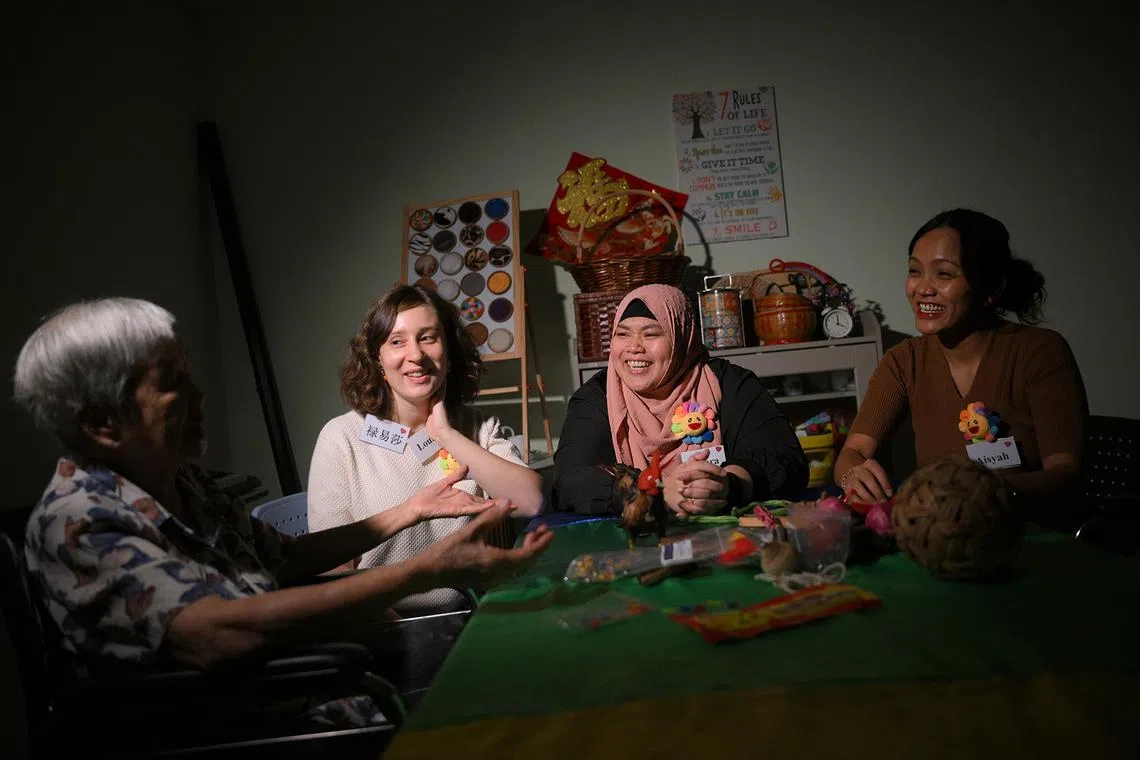
Medical social workers (from second left) Louisa Bielig, Nur Sahara Kamsani and Siti Aisyah Ismail at a reminiscence session with an elderly resident at Ren Ci @ Bukit Batok St. 52 nursing home on March 12, 2026.
OASIS stands for Older Adults Supporting In Sharing. And the programme is guided by the principles of 2R – Recollect and Reintegrate – incorporating intentional activities and conversations that journey through participants’ life stages, from childhood to adulthood.
To facilitate recollection, symbols, images and familiar props are used to trigger memories and create opportunities for participants to share their stories, perspectives and personal realities.

Childhood toys are used as reminiscence tools to gently evoke memories and spark meaningful conversations. One nursing home resident was drawn to a chicken figurine as it stirred up good memories from her past.
“Stories that bind us are among the most precious, for at our core, we are social beings who naturally yearn for connection, inclusion and belonging. When we discover a shared thread that links our experiences, it feels like uncovering a hidden gem – unexpected, yet deeply meaningful,” said senior medical social worker Nur Sahara Kamsani, 39.
OASIS 2R is part of Re²Ignite, a suite of programmes that has earned Ren Ci Hospital the OSWA (Practice) award this year.
Created by Ms Sahara and medical social workers Siti Aisyah Ismail, 35, and Louisa Bielig, 32, Re²Ignite has supported 238 people living with dementia and 95 caregivers since its inception in 2019 by providing interventions tailored to their individual needs.

Participants have seen improvements in mood, emotional control, social interaction, sense of purpose and day-to-day functioning.
It has not been easy running psychosocial reminiscence programmes for individuals living with dementia, Ms Sahara noted.
“The social workers balance caregiver expectations, limited resources and the challenge of measuring outcomes that are often intangible – such as dignity, belonging and moments of connection,” she said.
“The work is emotionally demanding, calling for resilience, reflective practice and strong ethical grounding.
“Yet, despite these challenges, our work is deeply meaningful as such programmes remain powerful spaces where stories are honoured, identities are affirmed and human connection continues to thrive.”
Shared journey of growth
Care Corner Singapore received the OSWA (Practice Research) award for its study, Building Pathways To Potential: Uncovering What Works From The MindBlown Pilot, which examined how to better support adolescents from lower-income backgrounds.
MindBlown was a four-year programme conducted from 2021 to 2024 and conceptualised in 2019 by a team at Care Corner Singapore led by principal social worker Michelle Wong, 38.

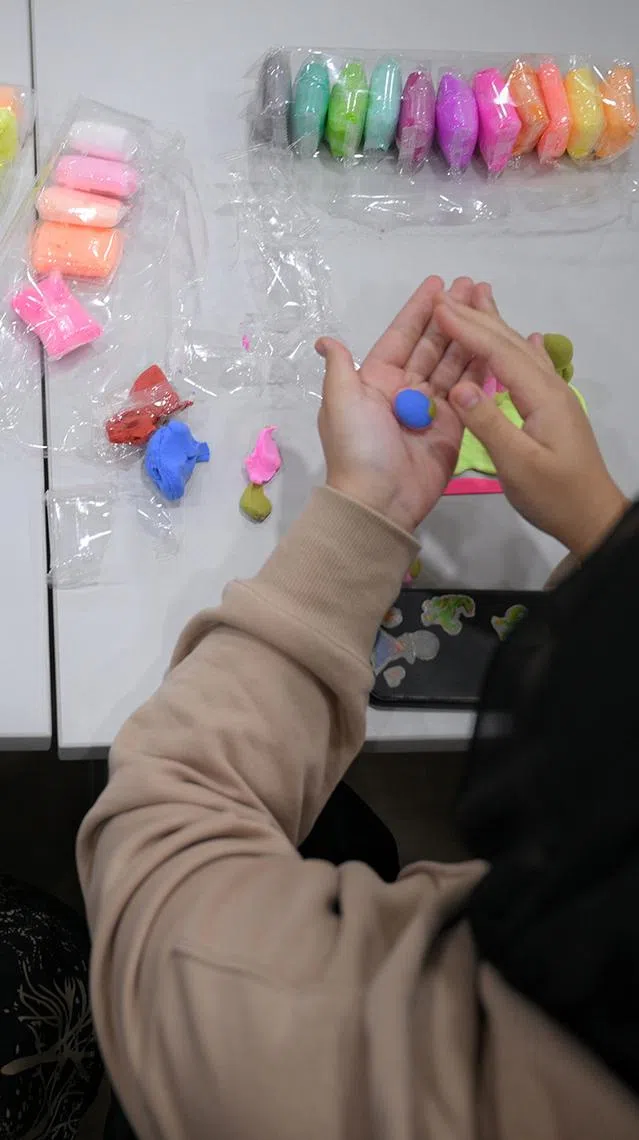
Care Corner Singapore principal social worker Michelle Wong facilitating a reflective clay activity for a mother-and-daughter duo.
It supported students from lower socio-economic backgrounds through their secondary school years by strengthening executive function skills within a supportive learning community involving parents and educators.
The study, which followed a cohort of 36 students through their secondary school years, confirmed adolescence as a critical developmental window where timely support can shape outcomes.
It also advanced understanding on the key conditions enabling adolescent learning.
The study found that adolescents are more engaged when learning is relevant, useful and stimulating. There should be room for experimentation, so that adolescents get to try, make mistakes and learn from the experience.
All this should be underpinned by a supportive environment that is safe and secure, where youth feel seen and soothed.
To connect meaningfully with adolescents, learning experiences should be intentionally designed to incorporate these mutually reinforcing conditions, the study said.

During a reflective clay activity on March 13, 2026, Nur Azlina Puteri Noor Azli sculpted a multicoloured figure of herself at the centre, surrounded by a star, flower and hearts.
It also highlighted the essential role of skilled, consistent and emotionally attuned practitioners, and found that strengthening life skills within a supportive ecosystem can reduce academic stress and boost resilience.
The study, which concluded in 2025, has shaped Care Corner Singapore’s approach to adolescent work. For instance, the organisation now provides earlier support for children, starting from upper primary and early adolescence, especially those from lower-income and ComLink+ families.
The study was shared at Learning Fest 2025, which was attended by more than 150 educators, social service professionals and community partners. It will also be presented at the 7th International Conference for Practice Research on July 7-9.
When Nur Azlina Puteri Noor Azli, 18, joined MindBlown in Secondary 1, she was “very shy and reserved” and hoped to make friends, while her mother, Madam Kamariyah Omar, 53, wanted to learn how to better support her through adolescence.

Ms Wong with Madam Kamariyah Omar (right) and her daughter Nur Azlina Puteri Noor Azli, who was with the MindBlown programme for four years.
Over four years, Azlina gained confidence, with her mother noting that the programme gave her daughter “the tools and confidence to engage, express herself and think creatively”.
“Previously, she would hesitate and look to me for answers. Now, she engages more, thinks out of the box and comes up with solutions,” recounted Madam Kamariyah during the study interview.
Although Azlina graduated from the programme in 2024, its impact endures. In a reflective clay activity on March 13, Madam Kamariyah shaped a rainbow representing the life skills that helped Azlina grow, while Azlina sculpted a multicoloured figure of herself at the centre, surrounded by a star, flower and hearts – symbolising friendships, support from the MindBlown team and her bond with her mother.
From leaving to healing: What shapes women’s decisions
The final OSWA (Practice Research) award went to a study on spousal violence at the post-separation stage, which examined how women make decisions after leaving an abusive spouse.
The study, Leaving Is Just The Start Of Ending The Relationship, was led by Care Corner Singapore’s assistant head and senior social worker Valencia Ng, 33, in collaboration with Associate Professor Ingrid Wilson from the Singapore Institute of Technology.

Care Corner Singapore senior social worker Valencia Ng was one of the researchers in a study on spousal violence at the post-separation stage, which examined how women make decisions after leaving an abusive spouse.
From July 2022 to March 2023, they conducted in-depth, one-on-one interviews with 11 women who had experienced spousal violence and taken steps to leave, such as filing for divorce or applying for a personal protection order. Follow-up group discussions with six participants were then held to validate and expand on the findings.
Participants were recruited through Care Corner Project StART and Care Corner Family Service Centres. Care Corner Project StART is a protection specialist centre that delivers integrated support services for individuals and families impacted by family violence.
The researchers examined the factors influencing women’s choices and their experiences with formal support, addressing a gap in Singapore-based studies on post-separation spousal violence.
Broadly consistent with international studies, the findings show that leaving an abusive relationship does not mean the difficulties are over.
“The most important thing this research showed me is that leaving is only the beginning,” said Ms Ng. “Many people ask, ‘Why didn’t she leave?’ But the more important question should be: ‘What happens when she does?’”
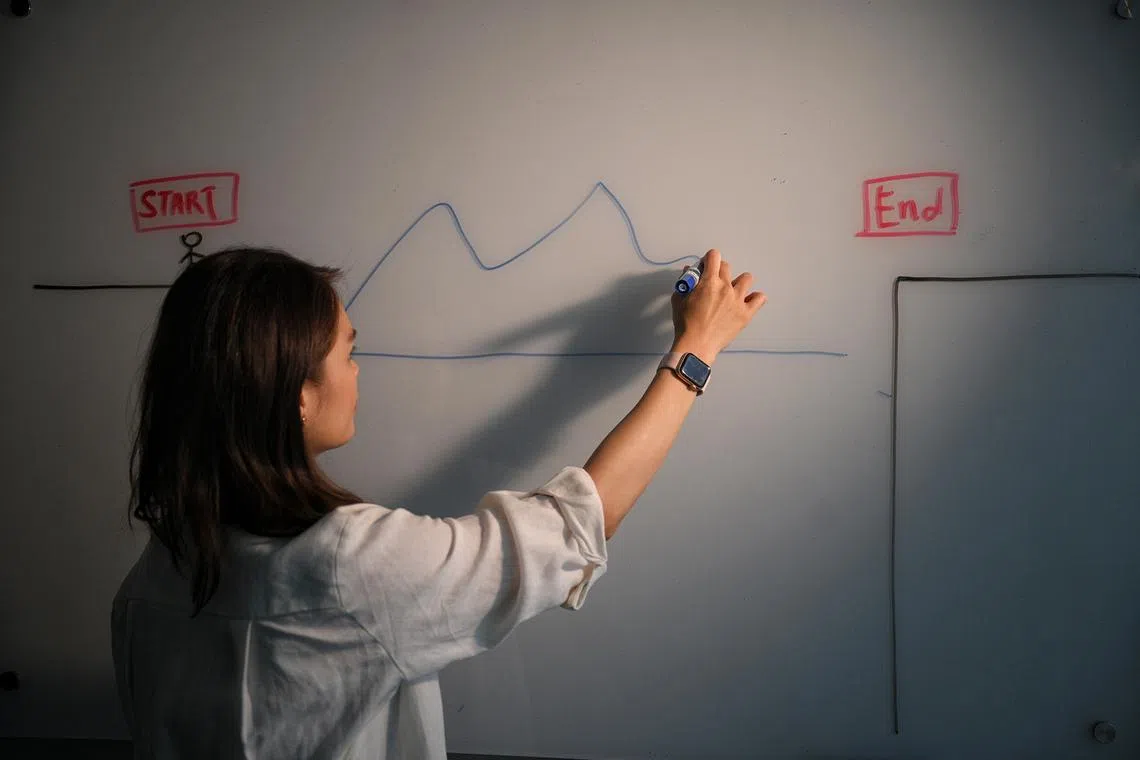
Ms Ng using an iceberg drawing as a visual aid to help women make sense of leaving abusive relationships. She invites them to reflect on where they see themselves in the diagram, whether at the starting point, within the uncertainty, or moving towards a sense of resolution.
Women continue to face safety concerns, financial pressure and difficult decisions around housing, employment and their children after they leave.
The researchers looked at how this plays out in Singapore as women navigate applying for personal protection orders, divorce proceedings, custody arrangements and HDB housing policies, often while managing caregiving and financial worries at the same time.
The study was presented at the European Conference on Domestic Violence in Iceland in 2023, and the inaugural women’s health conference by the Global Centre for Asian Women’s Health in November 2023, held in Singapore.
The researchers also found that cultural expectations around marriage and keeping the family together can weigh heavily on women’s choices. Their decision-making rarely follows a straight path; they are constantly balancing safety, finances and what is best for their children.

During counselling sessions, Ms Ng invites women to select cards – from a toolkit developed with the Singapore Institute of Technology – that resonate with their experiences, using these as conversation starters to explore their concerns, priorities and next steps.
“One mother we spoke to left with three young children for a crisis shelter,” said Ms Ng. “She was physically safe, but she had to turn down a job she wanted because it could not fit around childcare as a single parent. She ended up taking on two jobs across different time zones while her children slept.”
She added: “That is the reality for many women. Housing, jobs and finances are at the heart of whether a woman can sustain her decision to leave safely. We need support that goes beyond emotional care to include practical and coordinated support with legal processes, housing, finances and employment.”
Produced by: Grace Tay, Irene Ang, Mark Cheong, Neo Xiaobin and Yu Sheng Sin