Small bugs, big appetites: The tiny army upcycling Singapore’s food waste
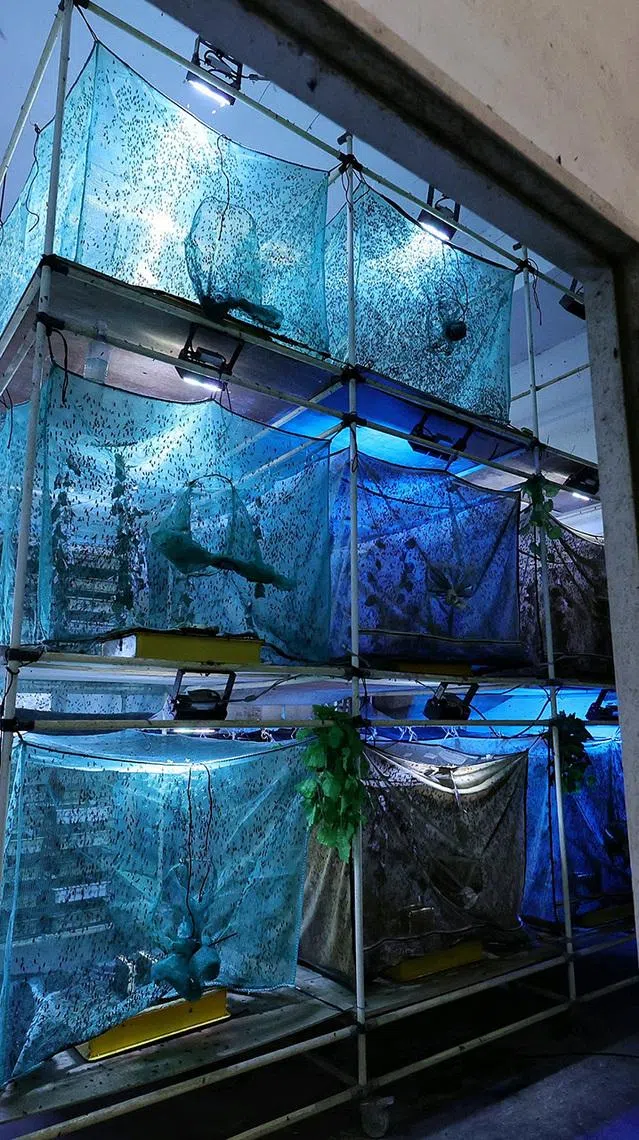
A constant, rhythmic low buzzing permeates a room in a nondescript building in Tuas. To the team at Ento Industries, it is the sound of productivity.
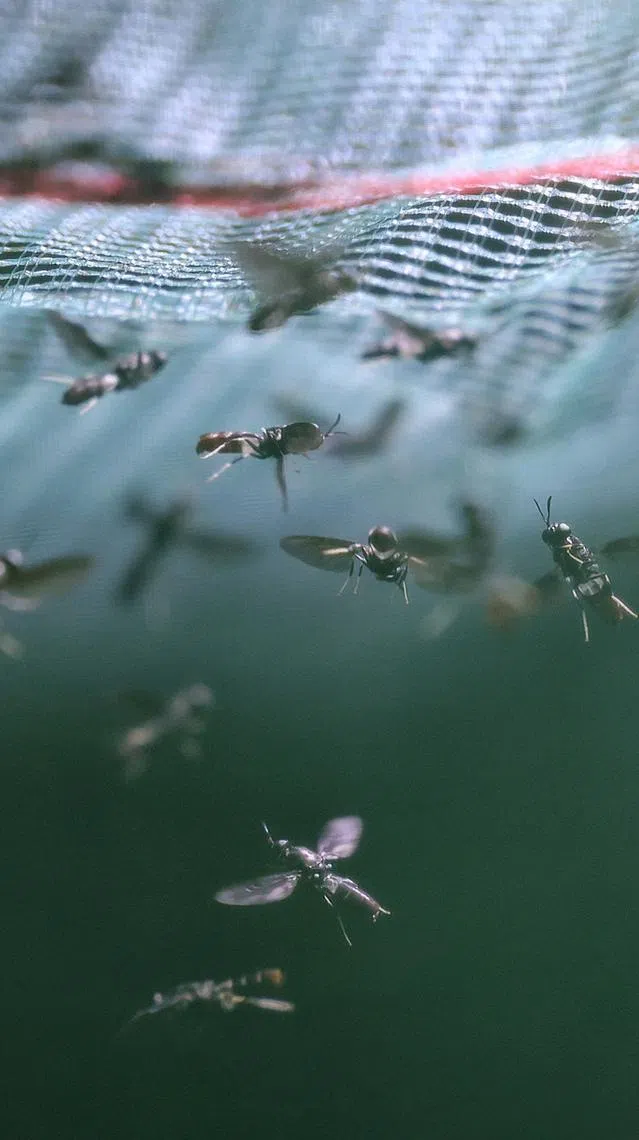
Here, in a race against time, adult black soldier flies (BSFs) are hard at work in the final five to eight days of their lives. Their mission? Mating and laying eggs.
The next generation of larvae that emerges will replace the millions wriggling in hundreds of trays of food waste placed in neat grids stretching across the adjacent warehouse space.
To the uninitiated, it may be an unsettling sight. To Mr Nathaniel Phua, it is the future of organic waste management.
“They are the engine behind how we turn waste into useful resources,” said the 36-year-old founder and chief executive of biotechnology company Ento Industries, which was established in June 2020 and is a subsidiary of local food waste management company Tiong Lam Supplies.

Mr Nathaniel Phua, the founder and CEO of Ento Industries, popping his head into the black soldier flies’ breeding enclosure.
Food waste made up about 12 per cent of Singapore’s total waste generated in 2024, at around 784,000 tonnes, yet only 18 per cent was recycled. The rest was incinerated.
At Ento’s 9,000 sq ft facility – one of the largest of its kind in Singapore – armies of BSF larvae are quietly helping to recycle more of the food waste by doing their part in a circular economy.

The black soldier fly facility at Ento Industries on April 20, 2026.
The flies’ life cycle begins when females deposit clusters of hundreds of eggs in substrate placed near a food source to attract them.
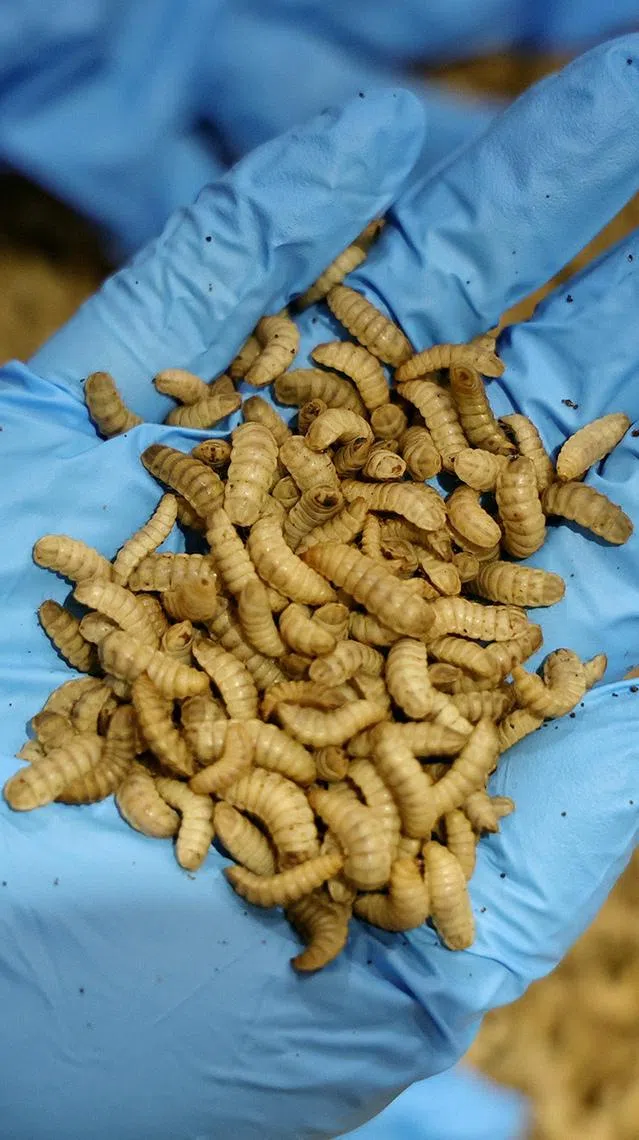
The eggs hatch within four to five days into voracious larvae, which can consume up to twice their weight in a day.

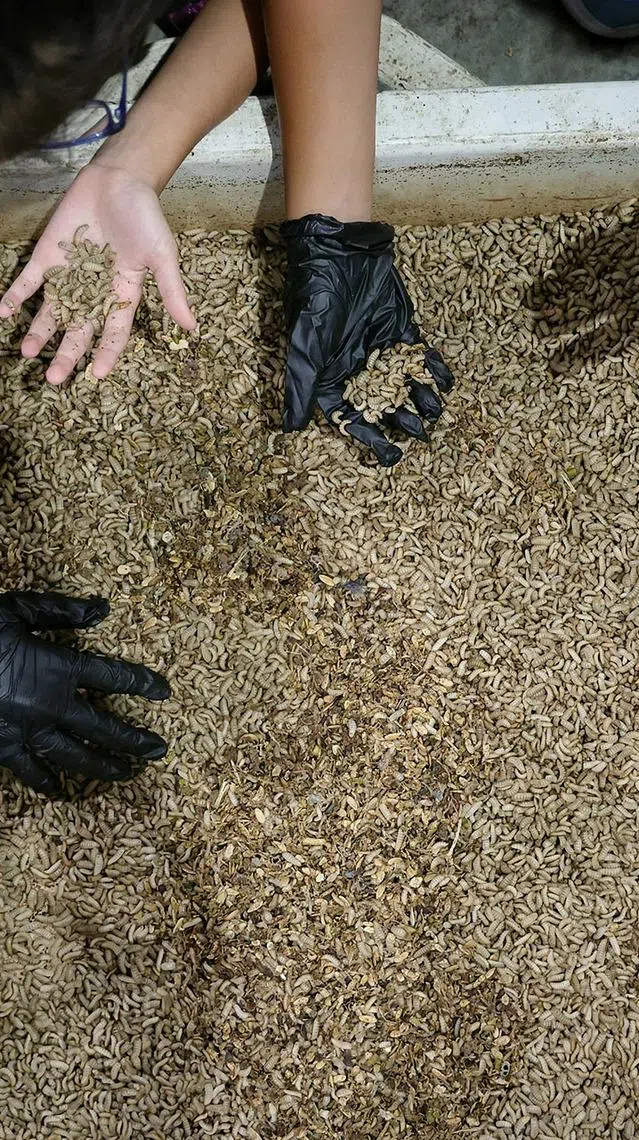
Black soldier fly larvae consuming the feeding substrate in Ento Industries’ facility on April 20.
After hatching, the larvae spend a short period in a nursery before being transferred to an automated feeding system.

Production specialist Cheah Poh Hui on April 20, turning on an automated system which puts five-day-old larvae through a feeding cycle, during which they will be fed a total of three times.
In each of hundreds of trays measuring 1m by 1m, around 60,000 larvae devour about 50kg of food waste from commercial and industrial sources, including food manufacturers, central kitchens, hotels and hospitals, over a feeding cycle of five to seven days.

Ms Cheah unloading banana peels into a grinder that turns the fruit waste into smaller pieces.

Ms Cheah transferring the ground banana peels from the grinder into a bin in the black soldier fly facility.
The waste – such as banana peels, vegetables and bread – has to be ground into smaller pieces, mixed with beneficial microbes and left to ferment in airtight barrels.

The banana peels are combined with other food waste and beneficial microbes in a mixer to be turned into a feeding substrate.

Ento employees on April 20, transferring the feeding substrate from the mixer (left) to an airtight barrel to ferment for one to three days.

Ms Cheah pouring five-day-old larvae into a 1m by 1m tray containing feeding substrate. Each tray has around 60,000 larvae devouring 50kg of food waste.
The result is a nutrient-rich substrate.
From there, the larvae take over.
Mr Phua said: “Without the larvae, we wouldn’t be able to recover nutrients and convert them into things like sustainable feed, giving discarded materials a second life.”
The life cycle is tightly managed.

Ms Cheah monitoring the automated process in which larvae are sorted by size and separated from their droppings, known as frass.
One to two days after the feeding cycle ends, the automated system sorts the larvae by size and separates them from their droppings, which are called “frass”.

The larger larvae being sorted into a tray during harvesting.
Only the top 5 per cent of the most active and well-developed larvae are selected to mature into adult flies, ensuring a strong and continuous breeding stock.
The selected larvae will stop feeding for seven to 10 days, and gradually darken in colour as they transition to the pre-pupal stage before being transferred to the breeding room.

The breeding room in the black soldier fly facility at Ento Industries.
After 10 to 14 days of transformation in the immobile pupal stage, the adult flies emerge. They will live for only five to eight days.
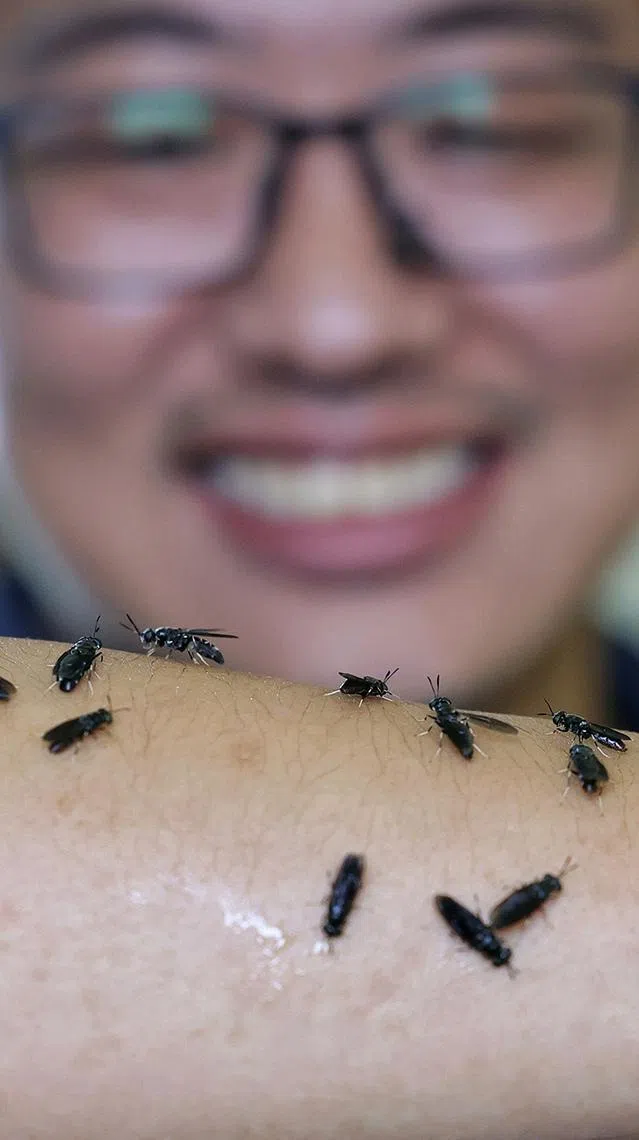
Having no functional mouthparts, these stingless adults do not eat and instead power through their sole focus – mating and egg-laying – using their larval fat reserves.

Black soldier flies searching for mates in Ento Industries’ breeding room in Tuas on April 20. Despite their wasp-like appearance, the adult flies do not sting or bite.
The remaining 95 per cent of larvae become protein-rich animal feed suitable for fish, birds and pets such as dogs and cats.

A live black soldier fly beside dried larvae, which are labelled as “EcoGrub” and used as animal feed, in separate containers displayed during a tour on April 5 for a group of visitors to Ento’s premises.
The frass is sieved and composted for two months into fertiliser that is sold to farms and landscapers.
This fertiliser contains chitin, a natural polymer which is found in crustacean shells and insects and which increases plant defences against garden pests.

The collected frass going through a round of sieving to remove uneaten food waste in the black soldier fly facility at Ento Industries.

Frass that has been sieved is collected in bags and composted for two months before being sold as fertiliser, mainly to farms and landscapers.
“While people often expect a strong, foul odour like typical food waste or in landfill environments, the BSF process actually produces a more earthy, compost-like smell,” Mr Phua said.
“It’s much milder and closer to natural decomposition rather than rotting waste.”
On the other end of the island from Tuas, at a kelong off Lorong Halus in the east, yesterday’s food waste comes full circle in producing tomorrow’s meal.

The kelong jointly operated by Ento Industries and Straits Seafood, off the Lorong Halus area in the east.
Here, Ento and Straits Seafood have jointly operated a tilapia farm for close to two years. Live BSF larvae become feed for the fish, which will be sold to restaurants.

Ms Samantha Sor, Ento’s co-founder and chief operating officer, feeding live larvae to tilapia at a fish farm jointly operated by the company and Straits Seafood off Lorong Halus on April 20.
According to Mr Phua, the meat from tilapia that feed exclusively on BSF larvae tastes sweeter and does not carry the earthy flavour that some people find unpleasant.
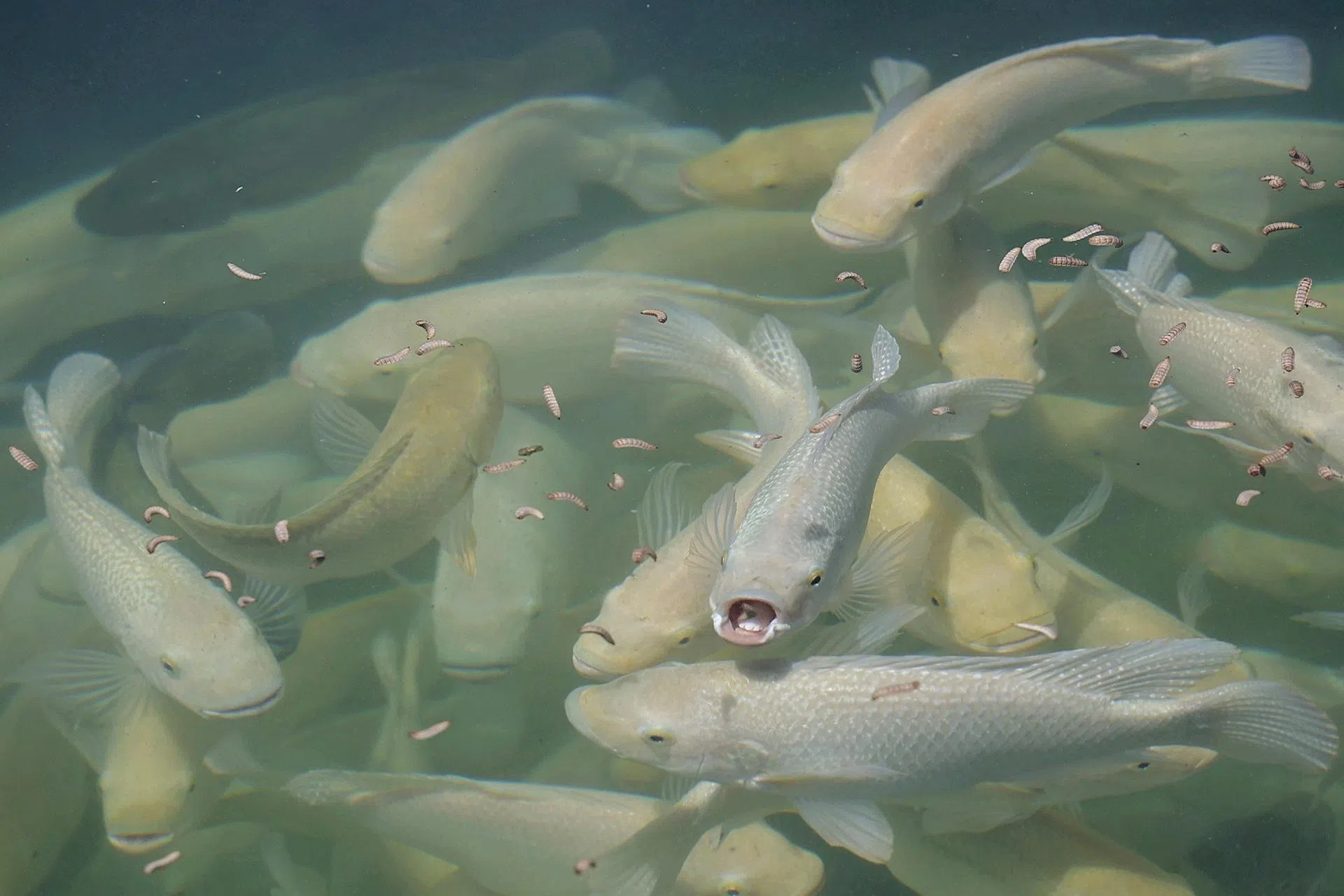
Tilapia feeding on live larvae harvested from Ento Industries at a tilapia farm.
Ento now processes between three and five tonnes of food waste a day, up from two tonnes in 2023.
It has 15 employees, including a dedicated team of five overseeing the BSF life cycle from egg to adult, as well as the production of animal feed and fertiliser.
While it had plans earlier to expand into Japan and Vietnam, Ento has chosen – for now – to focus on Singapore and Malaysia.
“There’s still a lot of potential to close the food waste loop here,” said Mr Phua.
On April 19, the same principles were on display in a very different setting – a run in the heart of the city.

Runners throwing used compostable cups into a bin after a hydration point during the Income Eco Run on April 19.
At the Income Eco Run at Bayfront Event Space, about 280kg of banana peels and 370kg of compostable drinking cups discarded by participants were collected in separate bins at the end of the race and transported by Ento to its Tuas facility.

Two participants dressed as bananas encouraging others to discard their banana peels into a designated bin after the Income Eco Run on April 19.

Income Eco Run participants throwing banana peels into a designated bin at Bayfront Event Space on April 19.
The peels were fed to the BSF larvae, while the compostable cups took a different route.
They were first crushed into smaller pieces and then mixed with fresh frass, which contains natural microbes and moisture that slowly break down the compostable material over time, similar to how decomposition works in soil.
Since 2025, Ento and Income Insurance have partnered to close the loop on waste generated from the event.

Workers consolidating bags of trash collected from the Income Eco Run at a collection point at Bayfront Event Space on April 19. Ento takes the bags containing banana peels and compostable cups.
“What excites us about this model is that it doesn’t just reduce waste, it creates value,” said Ms Shannen Fong, chief sustainability officer at Income Insurance.

“What runners discard on event day gets transformed into food and nutrients for plants and animals. That’s the circular economy in action,” said Ms Fong.
The run was launched as a carbon-neutral event in 2017.
Since 2023, it has allowed participants to choose their preferred distance to run for the zero-waste cause.

The Income Eco Run on April 19 drew more than 7,000 participants, who completed their run at the Bayfront Event Space. The event produces limited quantities of run T-shirts made of recycled materials for purchase.

Only children in the Kids’ Category receive a finisher medal, which is made from upcycled plastic bottle caps. Adult participants receive e-certificates rather than physical medals to minimise waste.
Income donates $1 for every kilometre clocked to green causes and education.
The event emphasises reducing waste and using smaller bibs, and encourages runners to reuse old run T-shirts.

A forklift operator unloading bins of waste collected from the Income Eco Run, for weighing at Ento Industries in Tuas.
That mindset shift is critical, said Ms Fong. “Sustainability is shaped by everyday choices,” she said. “What we use and waste directly affects our environment, health and cost of living.”

Small groups of visitors, comprising families with young children, entering the black soldier fly facility at Ento Industries on April 5.
Back in Tuas, a Sunday tour of the Ento facility with his parents and younger sister gave eight-year-old Caius Koh food for thought.
He was watching intently as adult BSFs buzzed around for romance in a breeding enclosure.
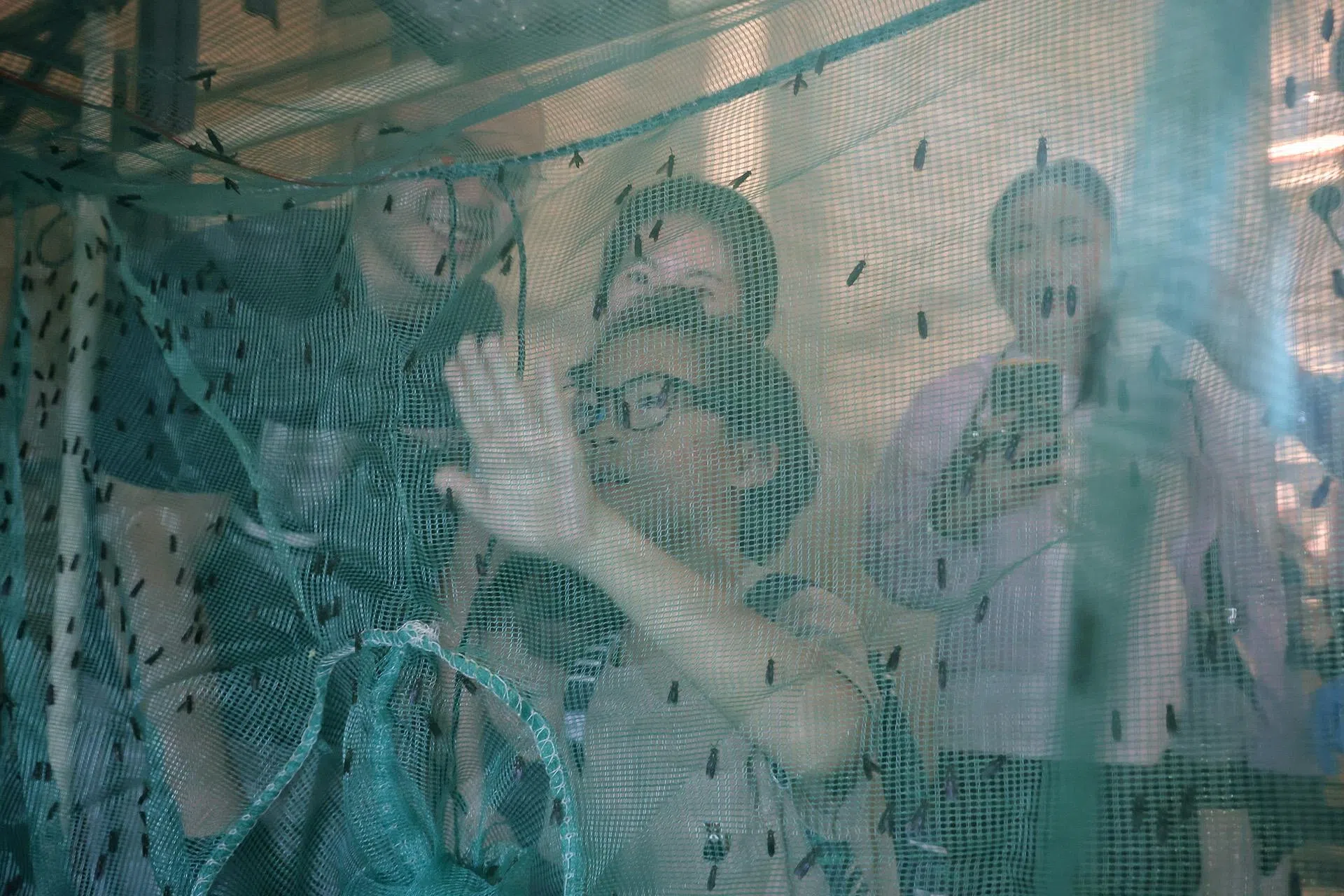
Eight-year-old Caius Koh taking a closer look at black soldier flies during a tour of Ento’s facility on April 5, accompanied by his parents – logistics manager Koh Bi Neng and homemaker Audrey Peh (partly hidden) – and younger sister Clara (partly hidden).
“I really enjoyed watching the larvae consume the food scraps. It is so amazing how quickly they do it,” said Caius, who is home-schooled.
“I also liked feeling them squirm in my hands – they were very cute... Later on, we also had a go at feeding the cute larvae to the pets in the facility, and I felt both happy and a little sad at the same time.”

A quail feeding on live larvae harvested in the black soldier fly facility.
Caius also found it interesting that after the larvae help to clear food waste, they can be turned into useful products like oil and food for animals, while the frass can become fertiliser for plants.
“It showed me that something so small can make such a big impact on the environment.”
His mother Audrey Peh, 37, said she knew Caius would enjoy the experience as “he loves bugs and insects, so this felt like a meaningful way to connect his interests with learning about the environment”.

Caius (centre) and his sister Clara (right) joining other children in getting a feel of the larvae during a tour of the black soldier fly facility on April 5.
“I wanted Caius to see real-life solutions to environmental challenges, and from this tour we actually saw how caring for the environment can be interesting and practical,” added Ms Peh, a homemaker.
“The visit was also a great opportunity for us to learn together as a family, and to start conversations at home about waste, consumption and how small actions can make a difference,” said Ms Peh.
Caius added: “I learnt that we shouldn’t buy or take more food than we can finish, so there’s less waste.”
Produced by: Adele Ong, Choo Li Meng, Grace Tay, Kevin Lim, Neo Xiaobin and Riana Zakir
Main photographs and videos by: Kevin Lim